HWT's Beginnings
From a century-scale historical perspective, Muscovite state behavior follows recurring and well-documented patterns. These methods—applied against neighbors, Western institutions, and peripheral states—are neither opaque nor novel once patterns accumulate.
In the early 1950s, the U.S. Congress Kersten Committee, drawing on hundreds of eyewitness testimonies across more than fifteen Reports (background), systematized these patterns into what became known as the Russian Blueprint—a method of expansion, control, and coercion. The framework was first summarized in tabular form (Table) and subsequently corroborated by additional witnesses, later scholarship, and contemporary OSINT-based research, including HWT's own longitudinal tracking.
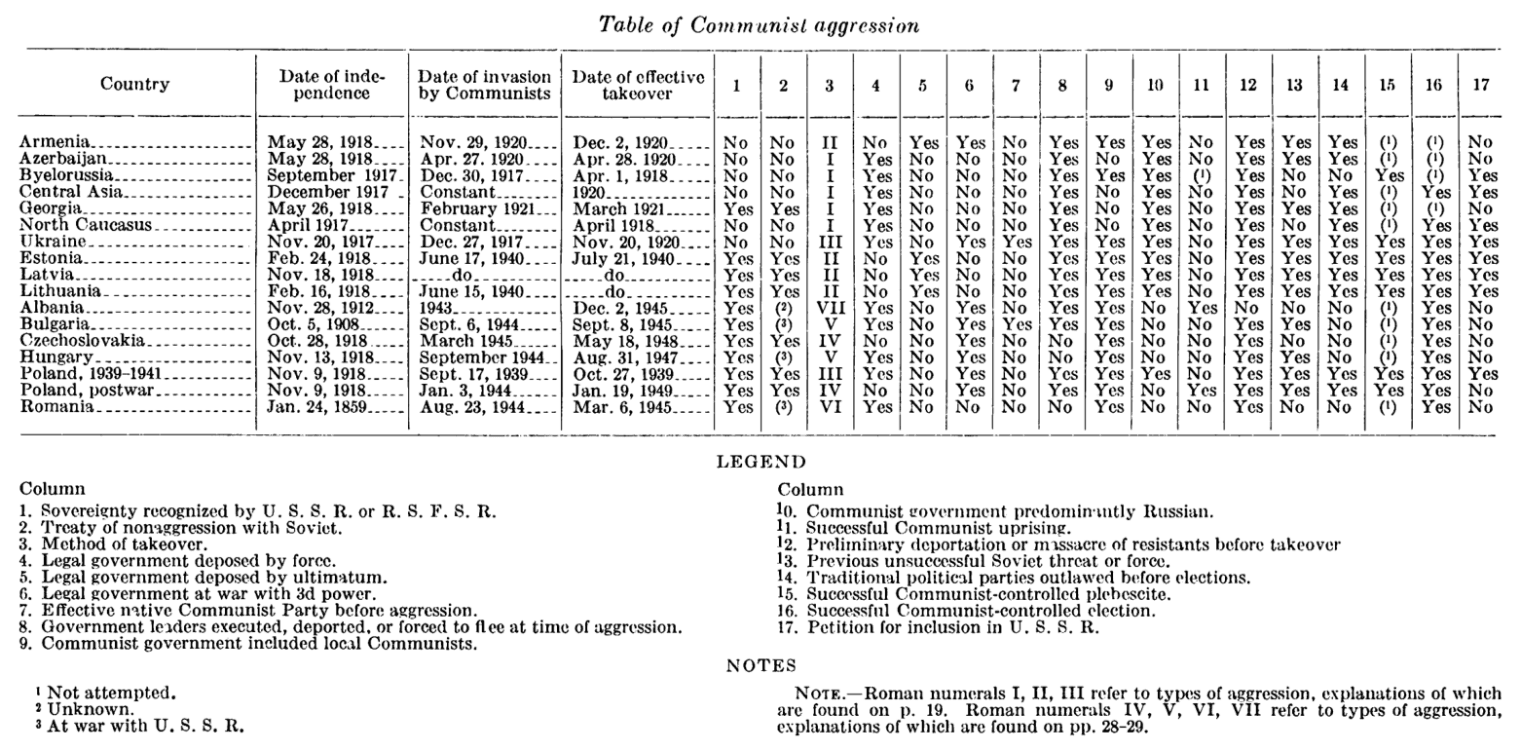
The Table was published in this US Congress Kersten Committee Summary report (p. 43) [PDF].
The Russian Blueprint is multistep, systematic, and built to be reused.
Kersten Committee interim reports document the application of this blueprint across distinct contexts. The 2nd interim report (p. 10 ff) [PDF] records testimony on the Russian occupation of the Ingush–Chechens, describing rapid, centrally planned mass population removal executed within a 24-hour window. The 8th interim report (p. 127 ff) [PDF] details how Muscovy combined internal subversion with external military pressure against Ukraine, forcing simultaneous internal and external conflict. These cases illustrate a consistent operational logic rather than isolated excesses or historical anomalies.
HWT builds on this historical record by structuring contemporary signals in a way that preserves continuity with documented patterns of past operations. By linking modern incidents to established methods, the project enables analysts to distinguish noise from recurrence and to evaluate present activity against a verified historical record of how such operations unfold in practice.